

New Orleans Travel Guide: Food, Mardi Gras, Hotels & More (2026)
This post contains affiliate links. I may earn a commission if you book through my links, at no extra cost to you.
New Orleans is one of those cities that reveals itself in layers, and the first few times I passed through — en route to somewhere else, a quick overnight, a work trip with a packed itinerary — I thought I understood it. I didn’t. It wasn’t until I started giving New Orleans actual time, the kind of trip where you have nowhere to be until dinner and dinner isn’t until nine, that the city finally showed me what it was. A slow morning on a wrought-iron balcony with a café au lait and the sound of a brass band warming up somewhere below. A long lunch at a white-tablecloth Creole institution that turned into an even longer afternoon. A hotel so beautiful and so deeply woven into the city’s history that leaving it felt like a small loss every time. New Orleans is not a city you can skim. It rewards the traveler who lingers — over a bowl of gumbo, over a second cocktail, over the particular quality of late afternoon light on St. Charles Avenue when the streetcar rolls past and the oak trees do what oak trees in New Orleans do, which is make everything look like a painting. I’ve been coming back for years, and I’m still not done with it. On my last trip to New Orleans, I was invited to experience one of the iconic hotels and interview one of the city’s most renowned chefs.
Here’s everything you need to know to do New Orleans properly.
Understanding What Makes New Orleans Different
Before you eat a single thing, it helps to understand the culinary DNA. New Orleans cuisine divides roughly into two traditions. Creole cooking is the city’s refined, French-influenced school — the Commander’s Palace lineage, the roux-based sauces, the layered complexity of dishes that took generations to develop. Cajun cooking is its earthier, smokier cousin, born in the bayou country outside the city and increasingly woven into the urban fabric over the decades. By now they’ve intertwined so thoroughly that locals argue about the distinction over a bowl of gumbo they’ve been eating their whole lives.
What matters for the visitor is simpler: you are in one of the few American cities where the food is entirely its own thing, irreducible and untranslatable. Eating here is not a tourist activity. It is the point.
What to Eat: The New Orleans Non-Negotiables
Gumbo
Gumbo is the city’s soul in a bowl, and no two versions are the same. Every cook has a roux philosophy — flour and fat cooked low and slow to that deep mahogany that gives the dish its backbone — and a strong opinion about whether okra belongs in the pot (it does). The common thread is depth: this is not food that was made in a hurry.
For the institution version, Dooky Chase’s Restaurant in Tremé is where you go. Leah Chase fed everyone from Ray Charles to President Obama at those tables, and the restaurant carries her Creole legacy forward with care. The gumbo z’herbes, a greens-based version made traditionally on Holy Thursday, became one of the city’s most beloved annual culinary rituals.
Po-Boys and Muffulettas
The po-boy is New Orleans’ great democratic institution: a soft French loaf loaded with fried shrimp, oysters, roast beef dressed with gravy, or whatever the cook decides that day. Order it dressed — that means lettuce, tomato, pickles, and mayo. Non-negotiable.
The muffuletta is the Italian immigrant contribution to New Orleans sandwich culture: a round sesame loaf loaded with cured meats and a sharp, briny olive salad. The Central Grocery on Decatur Street invented it in 1906. The lines are worth it.
Beignets and the Sweet Side
Beignets at Café Du Monde, dusted in powdered sugar and served with a café au lait, are something everyone must do at least once — ideally at 2 a.m., ideally with powdered sugar on every surface including your dignity. Beyond that, New Orleans has a serious pastry culture. Ayu Bakehouse on Frenchmen Street has become the city’s most exciting new bakery: their croissant-style king cake became an obsession, and their boudin and soft-boiled egg croissant is exactly as good as it sounds.

And then there is Commander’s Palace’s Creole Bread Pudding Soufflé with whiskey sauce, which is in a category entirely its own. Plan around it.
Oysters
The Gulf Coast produces some of the meatiest, briniest oysters in the world, and New Orleans has been eating them every way imaginable for centuries. Raw on the half shell is the purist’s move. Charbroiled — with butter and parmesan until the edges curl and sizzle — is the New Orleans move.
Peche Seafood Grill in the Warehouse District is the James Beard Award-winning benchmark: extraordinary raw bar, wood-fired grill, one of the most consistently excellent restaurants in the city. For something newer, Fives in the French Quarter opened in 2025 to immediate acclaim — a marble horseshoe bar under an antique chandelier, a superb selection of Gulf and East Coast oysters, and cocktails taken as seriously as the food.
The New Orleans Food Scene Right Now
The city’s restaurant scene has entered a genuinely remarkable era. When the Michelin Guide arrived in the South in 2024, New Orleans chefs were ready, and the recognition has only accelerated what was already an electric period.
Emeril’s in the Warehouse District has been transformed under E.J. Lagasse, Emeril’s son, who took over the kitchen in 2023 and reimagined the 35-year-old flagship entirely. It earned two Michelin stars — the only restaurant in the inaugural Southern Michelin guide to achieve that distinction. The tasting menu is one of the most sought-after reservations in the country right now.
Dakar NOLA, Chef Serigne Mbaye’s Senegalese tasting menu built around Gulf seafood and Louisiana produce, won the James Beard Award for Best New Restaurant in 2024 and has since landed on North America’s 50 Best Restaurants list. It is unlike anything else in the city and reservations open 30 days out and disappear fast.
Saint Claire, from the acclaimed chef behind Mosquito Supper Club, opened in 2025 on a four-acre oak-shrouded West Bank property. The menu is bayou-romantic — duck confit, rabbit rillettes, a caramelized shallot tarte tatin that locals are already devoted to. The setting alone is worth crossing the river for.
Evviva in the Marigny is the neighborhood restaurant the city needed: casual and convivial, with James Beard winner Rebecca Wilcomb cooking rustic, fire-influenced Italian food that feels deeply personal. The anchovy toast, the grilled shrimp, the roasted mussels — this is an evening, not just a meal.
Find New Orleans food tours and culinary experiences
Mardi Gras: How It Actually Works
Most people think Mardi Gras is a five-day party on Bourbon Street. That’s a reasonable conclusion to draw from the internet, and it is spectacularly incomplete.
Mardi Gras season in New Orleans begins on January 6th — Twelfth Night, the Feast of the Epiphany — and builds across weeks of parades, balls, and neighborhood celebrations before culminating on Fat Tuesday itself. There are more than 35 official parades organized by the city’s krewes, the private organizations that have been throwing Mardi Gras since the 19th century. Each krewe has its own identity, its own float aesthetic, its own throws (the beads, cups, and trinkets tossed to parade crowds), and its own level of prestige in the elaborate social hierarchy of Carnival.

The floats themselves are an engineering marvel most visitors never think about. They’re built year-round at Mardi Gras World, where more than 500 floats are constructed and housed for the parade season – and it’s a great way to spend an afternoon, trust me! Thirty full-time artists and around 300 seasonal artists work 365 days a year on these structures — some costing more than $1 million, some extending more than 10 trailers long. Each float’s chassis is custom-built to house two bathrooms and storage for the more than 300 pounds of beads thrown by each of the 50 riders. The floats begin in the sculpture area, where 80 percent are built from Styrofoam and the remaining 20 percent from fiberglass. From there they move through papier-mâché and paint, then to the engineering feat of mounting everything onto the chassis with generators for power. Mardi Gras World is open to visitors year-round and one of the most fascinating and underrated attractions in the city — a behind-the-scenes look at the art and craft that makes the whole spectacle possible.
Book a Mardi Gras World tour or New Orleans experience
A few tips for navigating Mardi Gras as a visitor: the parades that run through the Garden District and Uptown along St. Charles Avenue are the best for families and those who want the full krewe experience with room to breathe. Bourbon Street on Fat Tuesday is a different universe entirely — loud, crowded, and memorable in ways that are hard to describe to someone who hasn’t been. If you want beads, stand near the floats and make eye contact with riders. Bring a bag, bring layers, and commit fully.
The Neighborhoods: Where New Orleans Actually Lives
The French Quarter
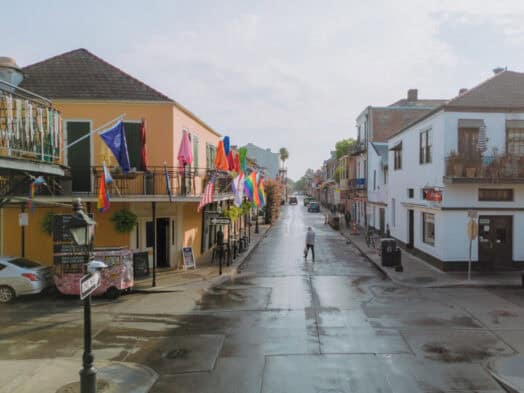
The oldest part of the city, settled by French colonists in the early 1700s, and still the place most visitors spend the majority of their time. Despite the name, most of the architecture is Spanish Colonial, rebuilt after fires in the late 18th century. Jackson Square, the St. Louis Cathedral, Royal Street with its antique galleries and exceptional buskers, Preservation Hall for acoustic traditional jazz without air conditioning or drinks — all of it is here and all of it is worth your time.
Bourbon Street at night is a singular experience. Go once. Know what you’re walking into.
The Garden District
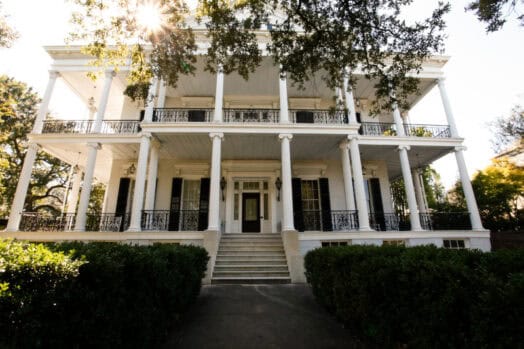
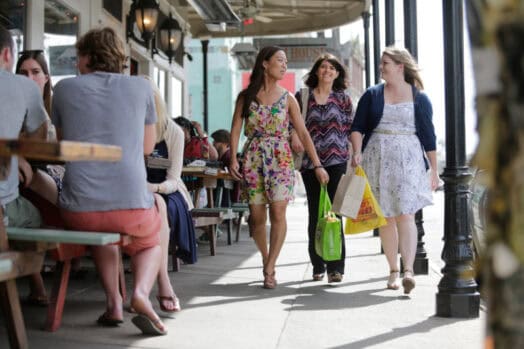
This is my preferred New Orleans base. The neighborhood sits along St. Charles Avenue, lined with 200-year-old live oaks, their branches draped with Mardi Gras beads that accumulate from parade seasons past. The antebellum mansions here are some of the finest residential architecture in America — grand, slightly excessive, beautiful in the afternoon light. Magazine Street runs through the neighborhood with six miles of independent shops, galleries, and restaurants that feel genuinely local rather than tourist-facing.
Lafayette Cemetery No. 1, with its above-ground tombs and winding brick paths, is free to visit and not to be missed. The St. Charles streetcar — the oldest continuously operating streetcar line in the world — runs right along the avenue and connects the Garden District to the French Quarter and Uptown with reliable, scenic ease.
Tremé
The oldest African American neighborhood in the United States and the acknowledged birthplace of jazz. Congo Square in Louis Armstrong Park is where enslaved people were permitted to gather and play music on Sundays — the origin point of the sound that changed the world. Walking through Tremé with that knowledge makes every block feel weighted with history.
Frenchmen Street and the Marigny
If you want live music the way locals actually experience it — intimate rooms, serious musicians, doors open to the street, zero pretense — Frenchmen Street in the Faubourg Marigny neighborhood is where you go. This is Bourbon Street for adults. The Spotted Cat, Snug Harbor, the Apple Barrel — within four blocks you can hear some of the most talented jazz musicians alive, for the price of a drink.
The Marigny itself is beautiful: colorful Creole cottages, a bohemian spirit, a genuine community feel that the French Quarter traded away decades ago.
Bywater
Bywater is the artsy, slightly eccentric younger sibling of the Marigny — colorful shotgun houses, street murals at every turn, indie restaurants, and the kind of neighborhood bar where everyone already knows each other. Bacchanal Wine, a wine shop with a backyard stage and rotating food pop-ups, is one of the great casual evening experiences in the city.
Book a New Orleans neighborhood walking tour
Things to Do Beyond Eating and Drinking
The National WWII Museum in the Warehouse District is consistently ranked among the best museums in the world and is one of the few places that earns that designation without argument. Plan a half day minimum, longer if you can. The immersive exhibits, the oral histories, the breadth of the collection — it is genuinely moving in a way that surprises most visitors who arrive expecting a standard history museum.
The New Orleans Museum of Art in City Park houses a strong collection of French and American art alongside a beautiful sculpture garden. The park itself — one of the largest urban parks in the country — is worth a morning on its own, especially in the early spring when the azaleas are blooming.
Cemetery tours are a New Orleans staple for good reason: the above-ground tombs, the voodoo history, the stories that cling to these narrow paths are unlike anything you’ll find in a conventional graveyard. St. Louis Cemetery No. 1 in the French Quarter, where Marie Laveau is buried, requires a guided tour to enter. It’s worth booking in advance.
The Steamboat Natchez, the last authentic steam-powered paddlewheel riverboat operating on the Mississippi, runs twice-daily cruises from the French Quarter waterfront. The live jazz on board is excellent and the view of the city from the river gives you a perspective that no walking tour can replicate.
Browse New Orleans tours and experiences
Where to Stay in New Orleans
The Pontchartrain Hotel — Garden District
If I’m being honest, there’s one hotel in New Orleans I keep returning to, and it’s the Pontchartrain Hotel in the Garden District.
It sits on a quaint corner of St. Charles Avenue, surrounded by those towering 200-year-old live oaks with their permanent garland of Mardi Gras beads from years past. The original streetcar route runs directly in front of the hotel, putting the whole city within easy reach while keeping you away from the French Quarter noise. Magazine Street and the central business district are walkable.
The building itself has a history worth knowing: it was actually New Orleans’ first luxury apartment building before converting to a hotel, and the guest list over the decades has included Frank Sinatra, The Doors, Rita Hayworth, and several U.S. presidents. Tennessee Williams lived here while writing A Streetcar Named Desire — which, given the streetcar stop directly out front, feels like it couldn’t have happened any other way.
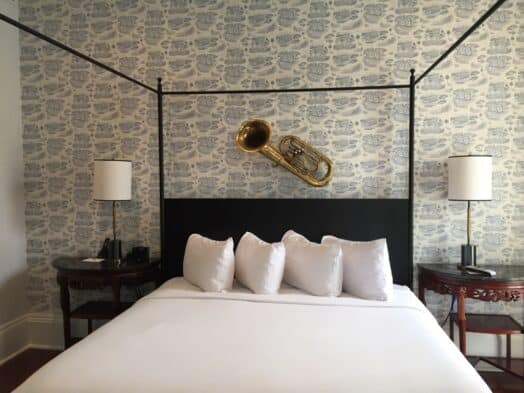
The 106 rooms are artfully decorated with gorgeous antiques, and the in-room mini bar stocked with locally crafted rum and vodka is a genuinely lovely touch. The hotel has two restaurants and two bars, which is rare for a boutique property of this size. The rooftop bar — Hot Tin, named in Tennessee Williams’ honor — has one of the best panoramic views of New Orleans and serves classic cocktails with care.
Its position on the St. Charles Avenue carnival route makes it particularly ideal for Mardi Gras. You can watch the parades from essentially your front door, then retreat to the quietest, most beautiful street in the city when it’s over.
Other Hotels Worth Knowing
Hotel Peter and Paul in the Marigny is a converted 19th-century Catholic church, rectory, convent, and schoolhouse — each building with its own personality, the former church now a dramatic bar and gathering space. One of the most visually striking boutique hotels in America.
The Eliza Jane in the Warehouse District occupies a series of historic 19th-century buildings — formerly a newspaper and a bitters factory — with an industrial-literary elegance and a lobby bar called the Press Room that’s worth a visit regardless of whether you’re staying.
Hotel Monteleone in the French Quarter is the classic choice: family-owned for over a century, home to the legendary Carousel Bar (which rotates slowly, one full revolution every 15 minutes), and beloved by locals and visitors alike for its authentic, unhurried luxury.
The Chloe in Uptown is a restored mansion with a pool, a serious cocktail program, and a refined but relaxed sensibility that feels more like a very stylish friend’s house than a hotel.
New Orleans FAQ
When is the best time to visit New Orleans?
Spring, specifically February through April, is the sweet spot — Mardi Gras and Jazz Fest both fall in this window, the weather is warm without being brutal, and the city is at its most electric. Fall (October to November) is a quieter, cooler alternative with fewer crowds and better hotel rates. Summer is hot, humid, and slow — but if heat doesn’t bother you, the rates are excellent and the city belongs more to the locals.
How many days do you need in New Orleans?
Three days is the minimum to feel like you’ve actually arrived. Four to five gives you time to eat properly, explore multiple neighborhoods, catch live music more than once, and not feel like you’re rushing. A week lets the city reveal itself at its own pace, which is ultimately how New Orleans prefers to be experienced.
Is the French Quarter the best place to stay?
It’s the most convenient, but not necessarily the best. For first-timers who want to be inside the action, a French Quarter hotel makes sense. For anyone who wants a more authentic, quieter experience with easier access to the city’s best restaurants and neighborhoods, the Garden District — and the Pontchartrain Hotel specifically — is a significantly better base.
What should I know about Mardi Gras before going?
Mardi Gras season begins in early January, not on Fat Tuesday. The best parades run along St. Charles Avenue in the Garden District and Uptown, and they’re far more family-friendly and spacious than anything on Bourbon Street. Book accommodation 6 to 12 months in advance if you’re going during peak parade weeks. Know your krewe hierarchy — locals take it seriously.
Is New Orleans safe to visit?
Like any major city, New Orleans has neighborhoods that warrant more caution than others. The main tourist areas — French Quarter, Garden District, Warehouse District, Frenchmen Street — are well-trafficked and generally safe with normal city awareness. Avoid walking alone late at night in unfamiliar areas and keep the usual travel street sense engaged.
What is the best food tour in New Orleans?
The East New Orleans food tours that cover multiple neighborhoods and several stops are consistently excellent for first-timers who want an oriented introduction to the cuisine. A ghost tour or cemetery tour that weaves in food history along the way can also be a rich way to understand both the culture and the cooking at once.
Do I need travel insurance for a New Orleans trip?
Even for domestic travel, I always recommend having coverage for trip cancellation, emergency medical, and lost luggage. Compare plans at Travel Insurance Master to find the right fit for your trip.